
I haven’t blogged on Christian Smith’s Souls in Transition in some months (for my entries on this excellent book see here, here, and here--and places in between). A link making the rounds on Facebook brought it back to mind. The link is to an interview of Kenda Creasy Dean who was one of the researchers on Smith’s earlier book, Soul Searching: the Religious and Spiritual Lives of American Teenagers (OUP 2005). Dean has followed up on that research with her own new book, Almost Christian: What the Faith of Our Teenagers is Telling the American Church (OUP 2010). Her conclusion concurs with Smith’s: instead of Christianity, American teenagers are embracing the religion of "moralistic therapeutic deism," a watered-down faith that portrays God as a "divine therapist" whose chief goal is to boost people's self-esteem. That teenagers whose religious beliefs are such leave any semblance of the Christian faith in their 20s is hardly surprising; there are, after all, better ways to boost one’s self-esteem than going to church and hanging around with others whose “faith” is similarly thin.
Of course, the actual content of orthodox Christianity centers around a holy God who is justified in condemning both sin and sinners to perdition but who--in himself--has atoned for the sins of his people. The results of failing to enjoy the benefits of God’s atoning work in Christ are frightful to contemplate, at least if we credit the Scriptures and the great bulk of those who stand in the Christian tradition.
Why would American teenagers substitute the thin gruel of MTD for the content of historic Christianity? Ask their parents. After all, concludes Dean, parents are the most important influence on their children's faith,. The ultimate blame for teens' religious apathy rests on adults. And not just any adults but the parents of the MTD generation--the Baby Boomers and those who trail just behind. The ersatz “virtues” of credentialing, success, niceness, and the like have replaced both the classical and biblical virtues. We--and I speak of my own cohort of Christians--have raised a generation more characterized by “I don’t care” than even “I don’t know.” Which reminds me of a poem by Sietze Buning,
“Today is review,
John,
What is your only comfort in life and death?”
“That wasn’t in the catechism lesson this week.”
“Ivan,
What do you mean by the Providence of God?”
“I can’t remember.”
“Willis,
What do you mean by a holy catholic church?”
“I don’t know.”
“Sietze,
What does God require in the third commandment?”
“I don’t care.”
“I don’t care?
I have bowed until I can bow no more.
Nobody says I don’t care in my class.”
You grabbed your grubby Stetson,
You opened the door.
Pale and shaking, you yelled,
“I would rather have you say God damn than I don’t care.
We laughed,
surprised at the words you knew.
It didn’t occur to me until now
that God damn and I don’t care
mean the same thing.
I wish I could tell you
who must have cried “Woe is me” all the way home
what a good catechism lesson that was
on the third commandment.
MTD teens are the children of parents who haven’t learned there is no difference.
(Sietze Buning was the pen name of the late Stan Wiersma, a native of Sioux County, Iowa and long time professor of English at Calvin College. “Delayed Reaction” can be found in Purpaleanie and other Permutations (1978). The object of review is the Heidelberg Catechism. The third commandment in the typical Protestant enumeration is "You shall not take the name of the LORD your God in vain.")
Showing posts with label Christian Smith. Show all posts
Showing posts with label Christian Smith. Show all posts


18 April 2010
Back to Souls in Transition
Long time no post on Christian Smith's Souls in Transition: The Religious and Spiritual Lives of Emerging Adults (2009). Quote for the day: "Religion doesn't have any authority per se, any more than shopping malls have authority over their customers. . . . Thus, when asked how she decided which of many interpretations of scripture is correct, one interviewee answered simply, "My own." (156)
'Bout sums it up, doesn't it?
'Bout sums it up, doesn't it?
14 March 2010
Some More “Souls In Transition”
Good news for at least some parents of emerging adults (per Chris Smith, Souls in Transition pp. 85-86): “When [i] parents are seriously religious, [ii] want their children to be seriously religious, and [iii] have raised them to be so, the emerging adults’ [iv] desire to have a good connection with their parents tends to encourage them to continue to affirm and practice their religious faith.” (Enumeration added.)
Working backwards, Smith contends that many EAs want to improve relationships with parents. Seems true to me. Points [i] to [iii] are straightforward enough but I wonder about the many EAs whose parents have little or no concern about religion; what social factors will even slightly encourage them to consider the place of religion in their lives? The answer would seem to be next to nil when we consider the dominant place of economic factors in contemporary life and the “black hole” of socializing (in person and distance) that occupies the lives of EAs. Not much room for religion.
Working backwards, Smith contends that many EAs want to improve relationships with parents. Seems true to me. Points [i] to [iii] are straightforward enough but I wonder about the many EAs whose parents have little or no concern about religion; what social factors will even slightly encourage them to consider the place of religion in their lives? The answer would seem to be next to nil when we consider the dominant place of economic factors in contemporary life and the “black hole” of socializing (in person and distance) that occupies the lives of EAs. Not much room for religion.
09 March 2010
More “Souls In Transition”
Per Chris Smith on p. 51 of his newest book, Souls in Transition: The Religious and Spiritual Lives of Emerging Adults: “One of the apparent effects of this apparently culturally relativistic and the continual self-relativizing to which it leads is speech in which claims are not staked, rational arguments are not developed, differences are not engaged, nature is not referenced, and universals are not recognized.”
Nothing surprising here. “Emotivism,” as Alasdair MacIntyre called it already in 1984 (in After Virtue) describes the state of affairs when people no longer believe there are rational ways of securing moral agreement. If true nearly 30 years ago, it’s hardly surprising it’s the warp and woof of the EA worldview today.
My law students may find it difficult to make the fine-grained rational arguments I’d like to see (in other words, there’s not enough “A” in the typical IRAC law school exam answer) but they certainly try; but then I suspect that pure emotivists don’t come to law school.
A bit more surprising is Smith’s conclusion on p. 67: “Interviewers could not, no matter how hard they pushed, get emerging adults to express any serious concerns about any aspect about mass-consumer materialism.” Then, again, maybe I shouldn’t be surprised. Why should I expect otherwise from a culture whose economy subsists by causing us to want to buy stuff we don’t need and which we can’t afford?
Nothing surprising here. “Emotivism,” as Alasdair MacIntyre called it already in 1984 (in After Virtue) describes the state of affairs when people no longer believe there are rational ways of securing moral agreement. If true nearly 30 years ago, it’s hardly surprising it’s the warp and woof of the EA worldview today.
My law students may find it difficult to make the fine-grained rational arguments I’d like to see (in other words, there’s not enough “A” in the typical IRAC law school exam answer) but they certainly try; but then I suspect that pure emotivists don’t come to law school.
A bit more surprising is Smith’s conclusion on p. 67: “Interviewers could not, no matter how hard they pushed, get emerging adults to express any serious concerns about any aspect about mass-consumer materialism.” Then, again, maybe I shouldn’t be surprised. Why should I expect otherwise from a culture whose economy subsists by causing us to want to buy stuff we don’t need and which we can’t afford?
07 March 2010
"Souls In Transition"
Per Chris Smith on pp. 45-46 of his newest book, Souls in Transition: The Religious and Spiritual Lives of Emerging Adults, “Most emerging adults have great difficulty grasping the idea that a reality that is objective to their own awareness or construction of it may exist . . . . They seem to presuppose that they are simply imprisoned in their own subjective selves. . . . They simply cannot believe in--or sometimes even conceive of--a given, objective truth, fact, reality, or nature of the world is that is independent of their subjective self-experience. . . . What emerging adults take to be reality ultimately seems to consist of subjective but ultimately autonomous experiences. People are thus trying to communicate with each other in order simply to be able to get along and enjoy life as they see fit.” (Emphasis added.)
The Emerging Adult Catechism Q. 1 “What is my chief end?” A. “My chief end is to get along and enjoy myself for as long as possible.”
I don’t get this sense from my largely EA students but law students (especially at Regent) are probably not representative of EAs generally.
The Emerging Adult Catechism Q. 1 “What is my chief end?” A. “My chief end is to get along and enjoy myself for as long as possible.”
I don’t get this sense from my largely EA students but law students (especially at Regent) are probably not representative of EAs generally.
21 February 2010
Emerging Adults

And you though age-based social groups went from childhood to adolescence to young adults to middle age to seniors! Now it turns out that at least in America there's a distinct social category of "Emerging Adults" comprising 18-29 year olds whose views on life, truth, and morality are sufficiently distinct to merit a separate status.
Following on his 2003 in-depth survey of American teens, Chris Smith and a team of researchers re-interviewed the older half of the same cohort five years later. Smith summarized the result on Saturday at WRPC’s Renew 2010 conference. (For those who want all the data and then some, buy Smith's Souls in Transition: The Religious and Spiritual Lives of Emerging Adults.) Much--for better or worse--about these “Emerging Adults” had not changed from five years earlier but the following randomly selected conclusions seem significant to me: Religion is not a threatening topic to EAs but neither is it a “life-driver;” EAs are largely indifferent to religion. Religious congregations are perceived as “elementary schools for morals.” You wouldn’t stay in 5th grade year after year, would you? So why continue to attend religious worship? Postmodern relativism is dominant (“What seems right to me” is the source of moral authority) except when it comes to science whose evidence trumps blind faith. (Someone else can comment on the epistemological incoherence of this.)
Smith’s research suggests that the religious “ideal types” of Emerging Adults fall into six categories: (i) committed traditionalists (15%), (ii) selective adherents (15%), (iii) spiritually open (these are not “seekers”) (15%), (iv) religiously indifferent (25%), (v) religiously disconnected (5%), and (vi) the irreligious (a category that didn’t exist when they were late teens five years earlier) (10%). According to Smith, these ideal types do not necessarily represent a continuum although the way they are listed might suggest EAs in, say, (iii) might eventually slip into (iv). Smith has funding to do these interviews again in 2013 so he might then draw some conclusions about inter-type movement.
FWIW, I didn’t get a chance to ask Smith but I wonder if (ii) comprises the “emergent church.”
Enough information for now. I’ll get to some data that suggests action next time.
20 February 2010
Are You a MTD?
Friday night the Renew 2010 conference at Westminster Presbyterian Church featured Notre Dame professor of sociology Christian Smith. Smith is best known as author of Soul Searching: The Religious and Spiritual Lives of American Teenagers. Based on 3,000 lengthy telephone interviews with teenagers (and their parents) as well as 267 in-depth follow-up personal interviews in 2003 and 2005, Smith concluded that the actual religion of American teenagers is moralistic, therapeutic, deism: (i) a God exists who created and orders the world and watches over human life on earth, (ii) God wants people to be good, nice, and fair to each other as taught in the Bible and most world religions, (iii) the central goal in life is to be happy and feel good about oneself, (iv) God does not need to be particularly involved in one's life except when he is needed to resolve a problem, and (v) good people go to heaven when they die.
For what it's worth, I doubt that the religion of American teenagers differs significantly from their parents' religion. In fact, it differs only slightly from what was called American Civil Religion back in the 70s. Significant by their absence (at least in the Christian account) is any awareness of sin, judgment, and salvation in Christ.
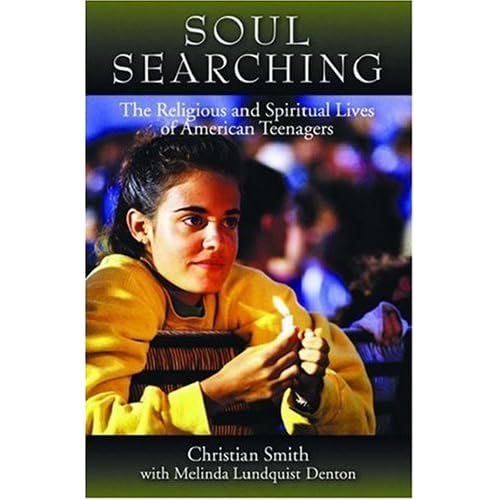 Saturday morning Smith went on to summarize the results of the results of interviews with the same cohort five years later. I'll save my summary of his findings but for now it's safe to say that the Church in America has utterly failed to communicate effectively the truths that virtually all Christian traditions have acknowledged for 2,000 years. The Church has always existed in some tension with American culture, or at least it should have. Some might be relieved that any such tension has disappeared. American culture has won. Amazingly sad.
For what it's worth, I doubt that the religion of American teenagers differs significantly from their parents' religion. In fact, it differs only slightly from what was called American Civil Religion back in the 70s. Significant by their absence (at least in the Christian account) is any awareness of sin, judgment, and salvation in Christ.
Subscribe to:
Posts (Atom)


