
Random unorganized thoughts (mine, not necessarily the speakers’) from three breakout sessions:
Addicted to Fun: “Boredom = deep, mordant indifference;” the more stuff we have to alleviate boredom, the more bored we become. Solution: renewed commitment to a Sabbath cycle (rest from entertainment).
The iGeneration: The self-referential nature of technology masks fear. Pseudo-relationships keep us away from real ones.
Worship: Don’t mistake sentimentality for stability; reformation, not repristination.
Showing posts with label Renew 2010. Show all posts
Showing posts with label Renew 2010. Show all posts
24 February 2010


23 February 2010
Anthony Bradley at Renew 2010

For parents: To do: starve the idols of comfort, ease, and success. To replace: these idols with Kingdom-centered living. To avoid: parenting in isolation--for many adults, children are a reflection of parental competency so performance-oriented parents want to avoid embarrassment at all costs. A good idea: parental and other adult connections should dictate children’s schedules, not vice versa. (This last point probably makes no sense to non-American readers who can’t imagine why children’s schedules would dictate anything; believe me, in America children dictate virtually everything.)
21 February 2010
Emerging Adults

And you though age-based social groups went from childhood to adolescence to young adults to middle age to seniors! Now it turns out that at least in America there's a distinct social category of "Emerging Adults" comprising 18-29 year olds whose views on life, truth, and morality are sufficiently distinct to merit a separate status.
Following on his 2003 in-depth survey of American teens, Chris Smith and a team of researchers re-interviewed the older half of the same cohort five years later. Smith summarized the result on Saturday at WRPC’s Renew 2010 conference. (For those who want all the data and then some, buy Smith's Souls in Transition: The Religious and Spiritual Lives of Emerging Adults.) Much--for better or worse--about these “Emerging Adults” had not changed from five years earlier but the following randomly selected conclusions seem significant to me: Religion is not a threatening topic to EAs but neither is it a “life-driver;” EAs are largely indifferent to religion. Religious congregations are perceived as “elementary schools for morals.” You wouldn’t stay in 5th grade year after year, would you? So why continue to attend religious worship? Postmodern relativism is dominant (“What seems right to me” is the source of moral authority) except when it comes to science whose evidence trumps blind faith. (Someone else can comment on the epistemological incoherence of this.)
Smith’s research suggests that the religious “ideal types” of Emerging Adults fall into six categories: (i) committed traditionalists (15%), (ii) selective adherents (15%), (iii) spiritually open (these are not “seekers”) (15%), (iv) religiously indifferent (25%), (v) religiously disconnected (5%), and (vi) the irreligious (a category that didn’t exist when they were late teens five years earlier) (10%). According to Smith, these ideal types do not necessarily represent a continuum although the way they are listed might suggest EAs in, say, (iii) might eventually slip into (iv). Smith has funding to do these interviews again in 2013 so he might then draw some conclusions about inter-type movement.
FWIW, I didn’t get a chance to ask Smith but I wonder if (ii) comprises the “emergent church.”
Enough information for now. I’ll get to some data that suggests action next time.
20 February 2010
Are You a MTD?
Friday night the Renew 2010 conference at Westminster Presbyterian Church featured Notre Dame professor of sociology Christian Smith. Smith is best known as author of Soul Searching: The Religious and Spiritual Lives of American Teenagers. Based on 3,000 lengthy telephone interviews with teenagers (and their parents) as well as 267 in-depth follow-up personal interviews in 2003 and 2005, Smith concluded that the actual religion of American teenagers is moralistic, therapeutic, deism: (i) a God exists who created and orders the world and watches over human life on earth, (ii) God wants people to be good, nice, and fair to each other as taught in the Bible and most world religions, (iii) the central goal in life is to be happy and feel good about oneself, (iv) God does not need to be particularly involved in one's life except when he is needed to resolve a problem, and (v) good people go to heaven when they die.
For what it's worth, I doubt that the religion of American teenagers differs significantly from their parents' religion. In fact, it differs only slightly from what was called American Civil Religion back in the 70s. Significant by their absence (at least in the Christian account) is any awareness of sin, judgment, and salvation in Christ.
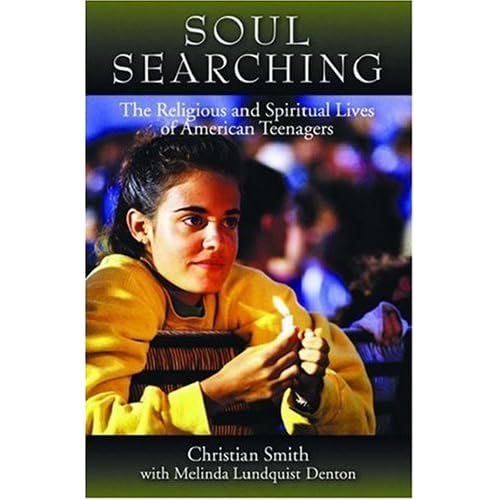 Saturday morning Smith went on to summarize the results of the results of interviews with the same cohort five years later. I'll save my summary of his findings but for now it's safe to say that the Church in America has utterly failed to communicate effectively the truths that virtually all Christian traditions have acknowledged for 2,000 years. The Church has always existed in some tension with American culture, or at least it should have. Some might be relieved that any such tension has disappeared. American culture has won. Amazingly sad.
For what it's worth, I doubt that the religion of American teenagers differs significantly from their parents' religion. In fact, it differs only slightly from what was called American Civil Religion back in the 70s. Significant by their absence (at least in the Christian account) is any awareness of sin, judgment, and salvation in Christ.
Subscribe to:
Posts (Atom)


