Showing posts with label Carl Trueman. Show all posts

21 April 2022

The End of "The Rise and Triumph of the Modern Self"

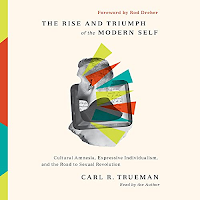
I've posted upwards of a dozen times on Carl Trueman's book, The Rise and Triumph of the Modern Self: Cultural Amnesia, Expressive Individualism, and the Road to Sexual Revolution. While I've made a few observations on what Trueman should have included, his book is a fine piece of cultural history. In his "Concluding Unscientific Prologue," Trueman summarizes his argument and then gives his readers a few thoughts on potential ways forward, at least for those who find themselves increasingly on the outs with the contemporary social imaginary and its increasingly coercive implications.

Trueman focuses his summary comments on three points. I will address two: the secularity of the contemporary liberal order and its focus on sexual expressivism. The liberalism that began to take hold in the second half of the seventeenth century turned its back on the long-held belief in the West that a largely unified Christian faith was crucial to a stable political order. At least in retrospect, the Continental Wars of Religion and the English Civil War were attributed to religious zealots who sought to impose a totalizing version of Christianity on a people and a polity. That this argument was incomplete was unimportant to the efforts to re-form the political order on the authority and consent of the governed. The will of the people gradually supplanted reason and revelation. And it is the triumph of the will that came successively to characterize the political, the economic, and the social orders. And now, Trueman concludes, the "culture of expressive individualism and of choice of identity is ours too." (386) In short, if the State and the market must recognize the unfettered individual will, then so must the rest of us. And nowhere is the duty of recognition of the other more acute than with respect to sexual identity.

Trueman acknowledges that this demotic turn has brought some goods, e.g., the emphasis that modern culture "places on the inherent dignity of the individual." (386) Yet,

The break with the past that modernity represents ... cuts us off from any agreed-on transcendent metaphysical order by which our culture might justify itself... We both are isolated from the past, where ends transcending the individual were assumed, and are left free floating in the present.* [In other words,] the reason why ethical and political discussions are so acrimonious  and futile today is that there is no commonly accepted foundation on which such discussions might constructively take place. (388)

Even for his largely traditional audience, Trueman tamps down expectations for a return to a Christian-dominant social order. And he is quick to point a finger at complicit Protestant in the United States that have for many decades "failed to reflect the historical concerns of the church in its liturgy and practice ... and [in] the manner in which it has frequently adopted the aesthetics of the present moment in its worship." (389) So, gay marriage is here to stay.

Otherwise for the future, Trueman raises several antinomies that remain in play: that the social costs of the sexual revolution remain inordinately borne by women, the difficulty of defining consent where there are disparities of power (for a fascinating discussion of the multiple notions of consent that are in play in different fields of the law, listen to an episode of The Private Law Podcast here), and transgenderism. None of these as-yet unresolved issues, however, bode well for the future of religious freedom. The scope for religious practices that are felt to transgress another's expressed identity is destined to shrink.

Finally, on a modestly more helpful note, Trueman concludes with three recommendations for churches in America that wish to hold to some form of essentialism and to reject the plasticity of the human self. First, such a church "should reflect long and and hard on the connection between aesthetics and her core beliefs and practices." (402) (By aesthetics Trueman means subordination of reason and truth to sympathy and empathy. In other words, subordinating stories to the Story. And to head off any misunderstanding, Trueman fully agrees that personal relationships must be compassionate but that compassion must appropriately be oriented to the good of the other.)

Second, the church must also be a community because community is crucial:

Each of us, in a sense, is the sum total of the network of relationships we have with others and with our environment. Yes, we possess a common human nature but hat nature has expressed--and does express--itself differently in different eras and cultures. (404, emphasis added)

Third, "Protestants need to recover both natural law and a high view of the body." (405) Hear, hear.

In sum, to thrive in the contemporary age of expressive individualism, churches must "exist as a close-knit, doctrinally-bounded community that requires her members to act consistently with their faith and to be good citizens of the earthly city so far as good citizenship is compatible with faithfulness to Christ." (407) Amen.

________________________

* For my thoughts from over a decade ago on the risks of an ungrounded foundation for human rights see Looking for Bedrock: Accounting for Human Rights in Classical Liberalism, Modern Secularism, and the Christian Tradition (here or here).

 For my observations on the theological legitimacy of natural law see God's Bridle: John Calvin's Application of Natural Law (here or here).

06 April 2022

"The Rise and Triumph of the Modern Self" 4.3

Chapter 10 of Carl Trueman's book, "The Triumph of the T," does an excellent job of situating the programmatic basis of the unity of the LGBTQ+ movement. Trueman demonstrates familiarity with the academic and mid-level popular texts that have framed the movements for legal and social recognition of the legitimacy of gays and lesbians.


Originally rooted in the sexed differences of male and female coupled with same-sex attraction, male and female homosexuals had little in common. Drawing on the work of Adrienne Rich (and later Germaine Greer), Trueman observes that "[male] homosexuality and lesbianism are not simply the male and female versions of a single broader phenomenon (erotic attraction to the same sex). [They] are actually two different phenomena because of how they stand in relation to the broader power structures of society ..." (342) Traditional social organization often privileges males. Thus, "lumping together lesbians and male homosexuals in a common category is an act of male domination."

If Trueman is correct, that when lesbians and gays come together politically, "bodily differences must be sideline or attenuated," (343) then what accounts for a united movement for legal and social acceptance? In short, "their shared victimhood as marginalized sexual minorities." (345) "Virtuous victimhood is a powerful catalyst for political coalitions in the modern world" (350) that for several centuries has identified the sovereign, psychological self as the "nature" of human nature. "Reality is inward and psychological, not outward and natural," and this is true of "all twenty-first century Westerners ..." (340). We have met the enemy, and he [sic] is us.

The transgendered movement compounds the elision of gendered sex seen first in the political unity of gays and lesbians. Sexed human nature may have been downplayed by gays and lesbians in the interests of political expediency but it was not denied. Transgendered individuals, however, deny any "biologically shaped approach in favor of a much more psychological and free-floating notion of gender." (353) Even so, the political virtue of victimhood permitted the addition of T to LGBTQ+.

Demands for legal recognition is one thing. The social demands of transgendered females is another: "resentment of transgender people, particularly men claiming to be women, [is] rife within the lesbian community," (354) or so Trueman reports. Why would feminists and lesbians feel resentment against their transgendered fellows? Drawing on the work of Janice Raymond, it is because

Transgenderism essentially depoliticizes the matter of being a woman. Being a woman is now something that can be produced by a technique ... The pain, the struggle, and the history of oppression that shape what it means to be a woman in society are thus trivialized and rendered irrelevant. (360)

Trueman then turns to Germain Greer who similarly argues that "sex-change surgery simply removes the most distinctive elements of male sexual anatomy; it does not add the critical components of womb and ovary." (361) Why are these components of female anatomy important? Because they "provide the experiences that constitute womanhood: menstruation and pregnancy." To ignore these essential [sic] features of biological femaleness is "to engage in a self-deception."

By making common cause first with gays and then with the transgendered, feminists generally and lesbians particularly have written their own epitaph. It is unlikely that, as The Economist recently suggested, future Olympics will divide competitors into two groups, open and female. Transgendered females will come ever more to dominate sport and, one wonders, the boardroom, at the expense of those born XX. Women, those blessed with the biology associated with XX chromosomes, will find themselves more marginalized as the decades wear on. The current TERF wars (here and here) are only a harbinger of things to come.

17 March 2022

"The Rise and Triumph of the Modern Self" 4.2.2

I've chosen to comment on Chapter 9 of Carl Trueman's book, "The Triumph of the 
Therapeutic," in two parts. 

In part 1, I addressed Trueman's skillful summary in The Supreme Court and Gay Marriage. I'm skipping his argument titled Ivy League Ethics where he devotes nearly ten pages to ethicist Peter Singer and his support of abortion and infanticide. I did not find this part of Chapter 9 as persuasive as the first. Trueman's effort to infuse Singer's Nietzschean ethics with expressive individualism seemed forced.

The third part of Chapter 9, Campus Anticulture, is solid. Recalling his discussion of Rousseau (in my words: "Rousseau identifies the cause of his 'sins' not in the sinful will but in the amour propre--the distorted desire for recognition created by society"), Trueman argues that the purpose of education has gradually changed from learning how to live well in the natural and social (dis)orders in which we find ourselves to learning that all social orders are the result of oppression and that so-called natural orders are merely awaiting the power of technology to reorder them to our likings. The triumph of the therapeutic self.

With respect to education, it is the case that "the changing understanding of selfhood brings with it a changed understanding of what does and does not constitute an assault on the self." (325-26) In other words, freedom of inquiry is no longer ordered to the ends of discovering the true or the good but may instead be seen to be a means of assault on the self. The notion of assault is no longer limited to injury to the body or property (or good name) but becomes "psychologi[zed], something that damages the inner self." 

For example, anyone who disagrees with an aspect of LGBTQ+ rights project is deemed bigoted as displayed in the furor around Middlebury College's 2017 invitation to Charles Murray. The psychologization of harm is foregrounded in this context by labeling of those who disagree in terms of phobia. Being tarred with the brush of phobia rules "out from the very start any notion that objecting to the fluidity that marks current notions of sex and identity could be based on any kind of rational reflection." (330) To paraphrase Martin Gurri, any challenge to the tenet of identity is blasphemy.

These brief observations lead to some even briefer comments on the recent revisions to the ABA Standards and Rules of Procedure for Approval of Law Schools. Even though it is a private entity in which membership is voluntary, the American Bar Association is the primary accrediting body for law schools in the United States. The power to accredit is important because many states require graduation from an accredited law school to take their bar exam. And without ABA accreditation, law students do not have access to federally-subsidized student loans. Thus, the private ABA exercises enormous public power.

In February 2022 the ABA House of Delegates approved changes to its accreditation standards 205 and 303. As revised, Standard 205 adds gender identity and expression, ethnicity, and military status to the list of grounds on which a law school may not discriminate in admissions and equality of opportunity. These changes will have little practical effect at most law schools. Revised Standard 205 exempts law schools with a religious affiliation from all its nondiscrimination provisions but "only to the extent" that the United States Constitution provides. In other words, the ABA recognizes that its accreditation standards amount to State action. But in any event, most religiously affiliated law schools will happily acquiesce to the revised non-discrimination rule.

Revised Standard 303 adds a new subsection (c). This should prove more interesting. 

(c) A law school shall provide education to law students on bias, cross-cultural competency, and racism:

(1) at the start of the program of legal education, and

(2) at least once again before graduation.

While the Standard does not prescribe the content of such education, official Interpretation 303-6 states that it is the "obligation of lawyers to promote a justice system that provides equal access and eliminates bias, discrimination, and racism in the law ..." One presumes that representation of persons or businesses conscientiously resisting application of expanding anti-discrimination rules will not be deemed "unprofessional," with all the negative ramifications such a conclusion would entail.

In light of The Triumph of the Therapeutic, the risk is great that Standard 303(c) education will be cabined by the sensibilities of selfhood. For example, will all questions addressing normative and professional questions about same-sex relationships be entertained? Or will a student (or teacher) who addresses the legitimacy of a lawyer's choice, say, to decline to represent a same-sex couple with regard to estate planning or adoption, be foreclosed because it risks assaulting the identity of another student?

Most incoming law students have been sufficiently conditioned by their experiences in secondary and undergraduate education to know better than to risk the patronizing of teachers or the ire of classmates. More's the pity. One wonders how well law graduates acutely sensitized to issue of identity can function in a realworld in which many clients and other professionals have not fully internalized the cult of the inviolability of the psychologized self.


14 March 2022

"The Rise and Triumph of the Modern Self" 4.2.1

Following his excellent analysis of the cultural and social imaginary that have opened the world of pornography to widespread acceptance ("The Triumph of the Erotic"), Carl Trueman turns in Chapter 9 to "The Triumph of the Therapeutic."  This chapter has little to do with the mid-twentieth century explosion of the field of mental health. Rather, Trueman demonstrates now-dominant notions of selfhood and personal fulfillment have come to expression in U.S. Constitutional law, bioethics, and contemporary university education. I will address only the first one in this post and that only briefly. I hope to spend more on the third aspect--the "anticulture" of much of higher education--in more detail along with a few comments about the American Bar Association's recently revised accreditation Standard 303.

The first subpart of Chapter 9, The Supreme Court and Gay Marriage, presents an excellent introduction for a non-lawyer reader (in fact, for most lawyers as well) to the series of Supreme Court cases beginning in1992 with Planned Parenthood v. Casey (best known for Justice Kennedy's rhapsodic "mystery of life" passage) and ending with the Obergefell v. Hodges in 2015 in which a majority found that State recognition of same-sex marriage is Constitutionally required. I won't summarize the summary--buy the book and read it for yourself--except to concur that the majority's rationale seems plausible only in a world of expressive individualism. Quoting the Court, "The first premise of the Court's relevant precedents is that the right to personal choice regarding marriage is inherent in the concept of individual autonomy." More succinctly, persons are constitutionally entitled to participate in gay marriage in order "to define and express their identity."  Neither "individual autonomy" nor "identity" are found in the Constitution. They are glosses drawn most directly from Planned Parenthood v. Casey. Casey, of course, had its own precedent but ultimately finds its textual bedrock in the Fourteenth Amendment to the Constitution.

It hardly needs to be said that same-sex marriage was not understood to be among the protected rights, liberties, privileges, or immunities that the drafters and ratifiers of that amendment had in view in the 1860s. To which the Court responded by asserting that "the generations that wrote and ratified the Bill of Rights and the Fourteenth Amendment ... entrusted to future generations a charter protecting the right of all persons to enjoy liberty as we learn its meaning." Even is such a claim were true, and even granting that the Court (whose average age is 80)--rather than legislatures--embodies the wisdom of future generations, it still does not follow that gay marriage is an aspect of liberty.

It is at this point that a couple of Trueman's observations are helpful. First, "[g]ay marriage did not make gay marriage plausible; the Supreme Court did not make gay marriage plausible. Gay marriage is plausible becomes of the wider transformation of the social imaginary." (303) In other words, a majority of the Supreme Court could not have imagined a "liberty" to participate in same-sex marriage unless American society at large had already come to believe that marriage exists as an instrument by which free individuals express their their mutual desires. Gay marriage is simply one aspect of the sexual revolution that in turn is "a manifestation of a much deeper revolution in what it means to be a self." (312) Obergefell was at most a few years ahead of the time when a majority of Americans would have reached the same conclusion without judicial intervention. (This is not to say that laws recognizing marriage as only between members of opposite sexes would have changed as quickly; that process would have been far more gradual.) Trueman is correct that for decades the reality of no-fault divorce had undercut the traditional understanding of marriage. Entry into and exit from marriage depends on no more than the continuing will of each party. And the individual will is (or should be) limited by nothing but mutual consent to self-expressive desire.

The specifics of Truemans's argument he follows well-developed understanding of his erstwhile colleague at The Witherspoon Institute, Robert George. Nonetheless, this first part of "The Triumph of the Therapeutic" reveals that the trajectory of Trueman's full argument, that "expressive individualism and the therapeutic concerns of psychological man have come to shape modern society" (336), helps make sense of this significant aspect of an important contemporary phenomenon. 

An aside: on page 315 Trueman remarks that "the sexual revolution is ... simply one manifestation of the wider revolution in selfhood that has taken place over the last four hundred years. (Emphasis added.) Trueman's argument in his book begins with Jean-Jacques Rousseau, who lived 250 years ago. Might this casual reference to "four hundred years" be something more than a typo? Might Trueman agree with me that the conceptual origins of the inward, immanent turn began with the trio of early seventeenth century thinkers Francis Bacon, Hugo Grotius, and Rene Descartes?

01 March 2022

"The Rise and Triumph of the Modern Self" 4.1

The march through Carl Trueman's book, The Rise and Triumph of the Modern Self, continues into Part 4 subtitled "Triumphs of the Revolution." The first chapter of this part, The Triumph of the Erotic, looks at two fields of human endeavor through the lens of Trueman's preceding cultural history: surrealist art and pornography, the elite and the demotic.

Trueman has led his readers on an argument beginning with Jean-Jacques Rousseau in the eighteenth century through some contemporary feminists with a focus on intermediate figures Marx and Freud. In brief, contemporary American culture represents a lowbrow fusion of neo-Marxist critical theory with neo-Freudian psychosexual reductionism. In briefer, the epitome of the contemporary American social imaginary is the freedom to define oneself free from anything--expect consent--that would limit personal sexual satisfaction..

Chapter 8's discussion of the connection between surrealistic art and Marxism was intriguing. That there was such a connection was a point André Breton explicitly made in his Manifesto of Surrealism. Even so, Trueman's argument for how surrealism led to the triumph of the erotic depends almost entirely on the work of Italian philosopher Augusto Del Noce. I found this section of Chapter 8 inadequately supported.

By contrast, the section of this chapter, "The Pornification of Mainstream Culture" demonstrated Trueman's own work. It is very good. Trueman begins this section by analyzing the success of Hugh Hefner's Playboy magazine. Magazines with titillating photographs had been around for decades but Hefner was the first to combine this feature with serious interviews. The wide range of interview subjects surprised me. They included Bob Dylan, Eldridge Cleaver, Fidel Castro, George Wallace, Jawaharlal Nehru, Bertrand Russell, Ayn Rand, and Jean-Paul Sartre. And of course, notably for the Baby Boom generation, presidential candidate Jimmy Carter.

Trueman notes that "the sexualization of pop culture, of which Playboy was an important part, is now all pervasive but is something of a comparatively recent development." (283) Part of the effect of this distinctive turn in popular culture, and what distinguishes it from the nudes of the Renaissance and later art, is the turn from beauty as a transcendent form to "the cult of sexuality." (284) In other words, today's portrayal of the female form has been eroticized. One can observe that the effects of constant, popular visual eroticism on teenage girls have been uniformly negative.

At this point Trueman considers the "shifting feminist attitudes to pornography." Early feminists characterized pornography as an example of male domination within a patriarchal society. Some more recent feminists have been more sanguine about pornography, with at least one trading in the notion of "ethically-sourced" pornography. In Trueman's words, "this speaks eloquently of the impact of the therapeutic and of expressive individualism [even] on feminism." (287)

More significant, however, is Trueman's discussion of the social significance of pornography. For both sexes, "fantasy worlds left unchecked have a habit of impinging on reality and remaking it in their own image." (288) How so in the case of pornography? By "detach[ing] sex from real bodily encounters." (289) The large majority of sexual encounters historically took place within a recognized and ongoing social relationship. Technologically mediated pornography breaks that connection even within a relationship like marriage. "This message--that sex is all about the individual and what personal satisfaction and pleasure he or she can derive from it without reference to the other" (289) characterizes the solipsistic modern self. Thus,

If freedom and happiness are epitomized in sexual satisfaction, then pornography becomes a medium, perhaps the obvious and certainly the easiest and least personally costly medium, of liberation and fulfillment. (290)
Trueman continues with additional trenchant analysis of the social effects of the triumph of the erotic that I won't take the time to summarize here. Suffice it to say that so far this is his best chapter.

15 February 2022

"The Rise and Triumph of the Modern Self" 3.2

In some respects Chapter 7 ("The New Left and the Politicization of Sex") of Carl Trueman's book follows simply from the conclusion of Chapter 5 (that all of human life is political in the sense that all societies are varying arrangements of power) and Chapter 6 (that human psychology can be reduced to ramifications of sexual desire). But of course there's more to the story. The fusion of neo-Marxism and post-Freudian libidinal theory was not inevitable. And while Trueman connects the dots between the two schools with some of the usual suspects (Gramsci and Marcuse (but not Jacques Lacan)), he also engages in serious interaction with the works of Wilhelm Reich and, more importantly, feminist writers Simone de Beauvoir and Shulamith Firestone.

Trueman's work with de Beauvoir and Firestone is especially cogent. More than others in the so-called second wave of feminism, de Beauvoir and Firestone anticipated significant aspects of current feminist thought that goes beyond equality in the spaces of law and employment and focuses more distinctly and critically (in the neo-Marxist sense) on the long-standing institution of the family. After quoting at length from Firestone's The Dialectic of Sex*, Trueman concludes that "the sexual resolution ultimately has one goal, the destruction of the family [because] the family is the primary means by which values are transmitted from one generation to the next [and thus] the family [is] the means by which false consciousness is passed on and replicated over time." (262-63) One might wonder if Trueman has conflated effect with intention.

In any event, I am not entirely persuaded that Trueman has accounted for all the historical contingencies that lay behind the politicized sexuality of today. While Trueman gives a shout-out to the historic Frankfort School, the bête noire of Evangelical worldview commentators, he skips over more contemporary public intellectuals in the tradition of the Frankfort School like Jürgen Habermas. Similarly, he fails to mention less anti-family feminist writers like Catherine Hall. It is not that Trueman should have worked Habermas and Hall into his book; it's that his intellectual history fails to account for why the views of the featured fusionists prevailed. 

Or maybe he does. Toward the end of this chapter Trueman observes that

Society now intuitively associates sexual freedom with political freedom because the notion that, in a very deep sense, we are defined by our sexual desires is something that has penetrated all levels of our our culture. Even the typical songs of teenage pop stars now proclaim that idea as truth, as do the commercials that use sex appeal to sell us consumer goods. ... Sex as revolution or sex as commodity; both are predicated on the idea of sex as the answer to human ills. (263-64, emphasis added)

But is Trueman's suggested order of cause and effect correct? In other words, would the sexualization of contemporary American political culture have occurred without the power of advertising to an American social imaginary already dominated by a consumerist, market economy? Drawing on my own reading of historians of nineteenth century America like Charles Sellers, Gordon Wood, and Daniel Walker Howe, I believe the answer is no. Self-expressive individualism was alive and well in the popular culture of the United States long before the 1960s. And the turn to a sexualized vision of self-expression owes more to the long-prevailing state of that culture than to the ideas of the intellectuals that Trueman mines.

Regardless of whether Trueman has properly ordered the reasons for the rise of a sexualized and politicized form of expressive individualism in America, it remains that such is the current state of affairs. In his epilogue to this part of The Rise and Triumph of the Modern Self make another significant observation: the contemporary importance of victimhood to identity. The psychologization of self-understanding "massively expanded the number of potential victims" and thus the number of persons who could plausible claim to suffer a violation of a right. A psychologized version of Mill's harm principle increases the number of wrongs and thus the corresponding number of rights of redress.

___________________________

*

And just as the end goal of socialist revolution was not only the elimination of the economic class privilege but of the economic class distinction itself, so the end goal of feminist revolution must be, unlike that of the first feminist movement, not just the elimination of male privilege but of the sex distinction itself: genital differences between human beings would not longer matter culturally. ... [T]he dependence of the child on the mother (and vice versa) would give way to a greatly shortened dependence on a small group of others in general, and any remaining inferiority to adults in physical strength would be compensated for culturally. 

03 February 2022

"The Rise and Triumph of the Modern Self" 3.1

With Chapter 6 (Sigmund Freud, Civilization, and Sex) Carl Trueman turns to the second part of  his account for the principle pathologies of contemporary life in the West. The first part described the work of some of the leading contributors to the inward turn, the psychologization of the human self. (Check here, here, and here.)

This inward turn could, of course, take expression in a variety of ways, as indeed it does. Trueman mentions phenomena like gratuitous consumption and the distractions of entertainment not to mention skin color or other identity-based ideologies. But in this chapter he focuses on a single aspect of the psychologized self, its sexualization. In some respects little in the way of a formalized account is necessary to explain the centrality of sex to the identity of human persons. Still, Trueman does a good job of explaining how Sigmund Freud's "scientific" explanation for why sexuality must be at the center of the existence of the individual and society was and remains important. Sex (and its repression) has always been important to social life but with Freud the repression of unrestrained human sexuality has been stripped of almost all of its justifications.

While Marx asserted that the cause of grinding social struggle in varying historical forms of economic production and the resulting forms of oppression, Freud "focuses the contrast between the natural authentic self and the civilized authentic self specifically on the conflict between natural sexual desires and the sexual restrictions demanded by life in [any] civilized society." (205) No wonder the doctrinaire Marxists hated Freud. But a neo-Marxist like Jacques Lacan brought the two forms of critical thought together. And while Marx believed that under pure communism there could be a classless--and non-oppressive society--Freud was increasingly dubious. Harmonization of the hyper-sexualized nature of the individual in civilized society could never lead to happiness for all. Only a group's alpha-male could give free rein to his nature. But his reign would be short-lived as another, younger and stronger male, would be waiting outside to take his place. Looking to Freud's Civilization and Its Discontents, Trueman suggests Freud was a libidenous Locke:

Primitive man [and by "man" Freud could only have meant males] was better off in knowing no restrictions on [sexual] instinct. To counterbalance this, his prospects of enjoying this happiness for any length of time were very slender. Civilized man has exchanged a portion of his possibilities of happiness for a portion of security.

I appreciate Trueman's acknowledgment that Freud believed that civilizational restrictions on sex were more than a prophylactic against a nasty, brutish, and short life. In other words, there are positive effects to limiting free sexual expression:

Freud sees a number of substitutive distractions in civilized society that ameliorate the unhappiness caused by the frustration of sexual desire. Science and art both offer avenues that allow individuals to take pleasure in life. In addition, for the ordinary person, there is religion ... (220)

Still, a simplistic version of Freud's sexual reductionism has permeated the Western social imaginary. Sex has become increasingly crucial to the identities of many individuals. But like all "identitarian" ideologies, it erases two of the most important facets of human existence: the utterly unique unrepeatability of our individuality and the unifying transcendence of our common humanity.

25 January 2022

"The Rise and Triumph of the Modern Self" 2.3

Chapter 5, "The Emergence of Plastic People: Nietzsche, Marx, and Darwin" brings the substantive portion of Part 2 of The Rise and Triumph of the Modern Self to a close. Carl Trueman's reading of Nietzsche is very good but, as he observes, his work with Darwin remains close to the surface. After all, the details of Darwin's theory of natural selection have long since been replaced with the science of genetics and forms of Neo-Darwinism generally. I appreciated his nuanced treatment of Karl Marx, which is a much better presentation than the cardboard cutout version one usually sees. I will limit my observations here to Marx because, as the grandfather of critical theory, the effects of his writings are more germane to my field of law.

Trueman correctly observes that "Marx was aware of how industrial production and the capitalism it represented were overturning traditional social structures and remaking society." (179). Trueman is certainly correct when he summarizes Marx to the effect that "this transformation had profound significance for the way human beings related to each other and understood themselves." Even if the net result of these profound changes is positive, it remains the case that most market-oriented conservatives have burrowed their heads in the sand when it comes to discussing the negative effects ("externalities" in economist lingo) of the 19th century market-industrial revolution. (See my posts on this topic here and here.) Trueman quickly observes, however, where Marx went wrong was when he claimed that "human nature and all that depends on such a notion [is] a function of the economic structure of society." Systems of economic relations are important, to be sure, but Marx's tunnel vision has continued to plague social analysis to this day.

Marx coupled his claim that the economic structure of a society was all-important with the contention that everything is political; the power to frame economic life is all-encompassing and oppressive. Neither art nor religion stands apart from economic relations; in fact, both are merely epiphenomenal superstructures existing to perpetuate the oppression of a system of economic production. Such a reductionism is absurd, which is why various neo-Marxisms have left it behind. (For an excellent analysis of the lesser-known development of neo-Marxism in the UK see Dennis Dworkin, Cultural Marxism in Postwar Britain (Duke University Press 1997)). And neo-Marxisms share the point of view that the power to oppress is the central category in all social analysis.

But this immanent reframing of history, tradition, culture, human sciences, religion, the arts, and the law is not the sole repository of neo-Marxists. "It is now a basic part of the social imaginary, and the deep cynicism about tradition and traditional authorities that pervades our culture in general points to demotic expressions of much the same attitude." (190-191) Neo-classical economics--the fetish of many on the contemporary Right--has grown in the same soil. In other words, even those who not identify oppression as the fulcrum for social analysis fall into the materialist matrix. Thus, Trueman provides a needed supplement when he observes that

As industrial capitalism tore apart and remade society in terms of its own revolutionizing of the means of production through technology, so human beings found themselves--and their very identities--caught up on the frenetic changes that industry, particularly its technological innovations relative to production, involved. (183)

And as he later concludes,

Technology has assumed a key role in the more radical context of making plausible the separation of biological sex and the concept of gender. This separation is now basic to much of the modern social imaginary and that clearly rests on the psychologized notion of self that emerged in the seventeenth and eighteenth centuries, and now dominates our contemporary world. (184)

For my earlier observations on The Rise and Triumph of the Modern Self go herehere, here, here, and here.

18 January 2022

"The Rise and Triumph of the Modern Self" 2.2


 "Unacknowledged Legislators: Wordsworth, Shelley, and Blake," Chapter 4 of The Rise and Triumph of the Modern Self, continues to showcase Carl Trueman's literary-critical skills. While the connection of Jean-Jacques Rousseau to the present age of expressive individualism is thin, the three eponymous English Romantic poets of of the early nineteenth century are a step closer. I will leave to to scholars of the English Romantics to evaluate Trueman's critical work but it certainly strikes me as the product of close, thoughtful reading.

Trueman begins this chapter where I left my previous post, how did the optimistic, self-loving ideas of Rousseau "become not simply the common currency of our society but so deeply embedded in such a way that most people never reflect on them?" (129-130) How did many in a society come to believe that it, rather than its individual members, was the source of so much of the evil and suffering present in the world?

That Trueman focuses on a set of poets picks up a theme from Rousseau, the importance of the aesthetic. For better or for worse, moral sentiments, the building blocks of ethics, have been for  many years a matter of tuning, not reasoning: "the idea that poetry (and therefore the poet) fulfills a profoundly ethical task in ennobling humanity by cultivating the correct sentiments through the medium of art." (130) Accepting the accuracy of what Trueman proceeds to draw from Wordsworth, Shelley, and Blake still leaves the question of precisely how the turns to the authenticity of nature (Wordsworth), the truth of nature (Shelley), and authenticity of natural sexual freedom (Blake) made it from the pages of poetry to the tacit understanding of the masses. But many chapters remain.

Trueman also addresses the eighteenth century cultural backdrop in England from which these poets sprang. In short, much had happened since the collapse of the overtly Christian Commonwealth under Oliver Cromwell in the seventeenth century and the turn of the nineteenth. For an account of what had happened, Trueman draws almost exclusively on the work of historian Faramerz Dabhoiwala. On page 150 of his book Trueman summarizes Dabhoiwala's insights into the shifts in England in the 1700's as

(1) the increasing importance ascribed to conscience (basically understood as natural instinct) as a reliable guide to moral behavior, (2) a growing public distaste for judicial punishment of consenting heterosexual transgressors (such as adulterers) of standard moral codes, and (3) the rising view that the moral laws based on external authorities such as the Bible might in fact be social constructs and actually stand problematically over against the natural laws governing human nature.

My only contribution at this point is that another book I'm reading, the recent biography of King George III, The Last King of America by Andrew Roberts, confirms the debauchery that characterized England's upper classes during this time. 

More acutely than Rousseau, the English Romantics identified religion--Christianity--as a principal source of oppression.

For Shelley, religion is a means of manipulation by which the powerful keep others subjugated and which is perpetuated primarily by the self-interest of those who have used it to gain the power they enjoy. God himself is the very prototype of human tyranny ... There is a clear connection in Shelley's mind between religion, political oppression, and restriction on sexual activity. (149)

A man far ahead of his times was Shelley and thus we should realize that the contemporary devaluation of the central role of marriage in social life is not a recent innovation.

I'm not entirely persuaded that "once aesthetics is detached from some universal understanding of what it means to be human, from some universally authoritative moral metanarrative, from some sold ground in a larger metaphysical reality, then aesthetics is king. ... When the sacred order collapses, morality is simply  matter of taste, not truth." (160-61) First, Promethean hopes for ever-increasing human power had been growing since the early 1600s. Second, the English Romantics fully believed that human nature universally yearned to be free. But crucial to their social imaginary was the deep-seated belief that human suffering was not a consequence of an equally universal bent toward sin. Finally, the centrality of the aesthetic to their program of liberation reflected their own privileged positions. Yet adding aesthetic technique to the toolkit of the market certainly help explain our current state of affairs. The utilitarian mindset has swallowed all.

Earlier posts on The Rise and Triumph of the Modern Self here, here, and here.


14 January 2022

"The Rise and Triumph of the Modern Self" 2.1

Earlier comments on Carl Trueman's latest book, "The Rise and Triumph of the Modern Self" here, here, and here.

Chapter 3 (The Other Genevan) demonstrates Trueman's most original work thus far. Jean-Jacques Rousseau (and not John Calvin) gets a close treatment. Trueman credits Rousseau's Confessions as the most important psychological autobiography since the Confessions of Augustine of Hippo. Unlike the namesake work, however, Rousseau identifies the cause of his "sins" not in the sinful will but in the amour propre--the distorted desire for recognition created by society. Evil actions comes from without, not within the human person. No doctrine of original sin in Rousseau's theology.

Rousseau may be off to a bad start but Trueman observes an important, positive feature in Rousseau's subsequent works. Following Adam Smith, Rousseau identifies the sentiments as the locus for ethical reflection. The sentiments are not rational and cannot be derived by analytic reasoning. Instead, for Rousseau the foundation for ethics was aesthetics: "The virtuous person is the one whose instincts, whose sentimental or emotional responses to particular situations, are correctly attuned." (121) Thankfully, Trueman does not simply discount Rousseau's approach to ethics. As all should appreciate, "sentiments, emotions, and aesthetic consideration form an important part of ethical activity." (122) After all, on several occasions the Gospels refer to Jesus' "compassion" (σπλαγχνίζομαι (splanchnízomai)) as the motive for his actions. (Some of my reflections on the waning of the category of beauty among Christians and conservatives here.)

Rousseau was not an ethical subjectivist. He believed in "a universal human nature possessing a conscience that [was] the same for everyone." (122) Without a robust notion of sin, however, Rousseau's ethical optimism was unfounded. Even if our consciences are the same, our perverted wills suppress what should be clear. Yet his faith that evil is "out there" in society and not deeply rooted in fallen human nature is a current commonplace. Thus, on Trueman's account "Rousseau lays the foundation for expressive individualism through his notion that the individual is most authentic when acting out in public those desires and feelings that characterize his inner psychological life." (125) How that foundation ultimately became the superstructure remains to be argued.

06 January 2022

"The Rise and Triumph of the Modern Self" 1.2.2

Earlier posts in this series here and here.

In Chapter 2 (Reimagining Our Culture) of The Rise and Triumph of the Modern Self, Carl Trueman makes three significant arguments. I discussed two of them in my previous post. I have more difficulty with the third--that modern West is antihistorical--which I will address here.

"The rejection of second-world practices and beliefs is epitomized by third-world rejection of the past as worthy of respect and as a source of significant wisdom for the present." (93) How are we to understand this assertion? That history has no place in the social imaginary of the present? Or that history has nothing to teach the present? The first take is clearly wrong. The social imaginary of the third world is greatly interested in the past. Works of cultural history ranging from The 1619 Project to Jesus and John Wayne to one side, and The United States: A Christian Nation, on the other, demonstrate that the genre of history continues to draw readers and money. On these popular contemporary accounts, Trueman correctly observes that the world is divided into two: "victimizers and victims, with the former being the villains and the latter the heroes."  (95) Not much nuance.

Yet history in service to politics or ideology is nothing new.  Before the professionalization of the historian’s craft in the nineteenth century, historical knowledge tended toward either a bare chronology of events or an expanded biography either in favor of a person or position (hagiography) or as an attack on a person or opposing position (“demonology”). Through the course of the nineteenth century, history became a narrative discipline, a story-telling art. The stories it told were about the organization of power and authority, which is why it focused on political and military matters.

Of more concern to me is Trueman's claim that "we can see the modern turn to the weak and the marginalized in the academic discipline of history to be a scholarly manifestation of the wider victimhood culture ..." (95) Surely Trueman cannot mean that he subscribes to the "great man" school of historical writing. History from the bottom-up has been central to the academic discipline since early in the twentieth century when the narrative paradigm of historical writing began to come apart. There were many new interests and problems that no longer “fit” in the traditional form. The previous narrative synthesis was replaced by the search for the anomalous fact. In other words, it drew on a greater variety of textual and data resources.

So perhaps we should focus on the second part of Trueman's lament, that history is no longer a significant source of wisdom for the present. Depending on what Trueman's means by wisdom, this too is overstated as the works noted earlier attest. Yet Trueman is certainly onto something. The very notion of wisdom finds little place in the contemporary third-world social imaginary. Techne rules all. With neither an immanent (first-world) order to reality nor a transcendent (second-world) account of meaning, we are left to our own devices to make order out of chaos, to create our own identities. Practical wisdom, phronesis, is about discerning ends but if our ends are simply what we choose, we need more and better technique, not wisdom.

Finally, what should be the use of history? What can we learn from it? Instead of writing more I will quote what Micah Mattix recently wrote about the purpose of reading great books.

In one of his letters to Lucilius, Seneca argues famously that liberal studies do not make students virtuous. This was somewhat against the grain at the time. He states emphatically that liberal studies — in poetry, astronomy, mathematics, history — offer “nothing” in terms of virtue. Yet, he continues, students should still study poetry because it “prepares the ground” for virtue:
“‘Why then do we educate our sons in liberal studies?’ Not because they can confer virtue but because they prepare the mind to receive it. Just as what long ago used to be called basic grammar, by which children acquire the rudiments of their education, does not teach the liberal arts but prepares the ground for them to be acquired in due course, so the liberal arts themselves do not lead the mind to virtue but clear the way for it.”

Like all the liberal arts, history may be the means by which we recognize our limits, weaknesses, and blind spots. In turn, history may be a means by which we learn that we need wisdom. And having come that far, we may even find wisdom in history.

04 January 2022

"The Rise and Triumph of the Modern Self" 1.2.1

A few days ago I posted some initial comments on Chapter 1 (Reimagining the Self) of Carl Trueman's book Rise and Triumph of the Modern Self. Chapter 2 (Reimagining Our Culture) is too short to do justice to the scope of Trueman's argument. I largely agree with the broad contours of two of his conclusions: first, that the culture of the modern West is "third-world" in Philip Rieff's sense that it does not purport to be justified by the sacred. Second, drawing on Alasdair MacIntyre, that its practical ethics have reduced to emotivism. But Trueman's third argument, that modern West is antihistorical, is too broadly framed. With some clarifications, however, I believe I can restate it in a way that makes it more accurate. I will limit my comments to the first two of Trueman's points in this post.

Chapter 2 begins with another warning against idea-based worldview-ism:

[Charles Taylor's] idea of the social imaginary is useful in highlighting the fact that most of us do not self-consciously reflect on life and the world as we live in it but instead think and act intuitively in accordance with the way we instinctively imagine the world to be. [In turn], that view is shaped by the environment in which we live ...

Trueman then turns to Rieff's classification of cultures into three types: first and second cultural worlds are those in which the interdicts of morality depend on something transcendent, whether an inscrutable Fate whose dictates are derived from myth (first world) or a revelation from God (second world). Notwithstanding a transcendent source of moral order, there would still be plenty of battles over the content of morality derived from the stories of a distant past or from competing interpretations of sacred revelations. In other words, neither first- nor second-world morality is free from conflict. It remains the case, however, that there was a common belief in a sacred order behind or beyond the contemporary culture of either of the two worlds. For better and worse, denizens of particular first and second worlds believe there are more or less correct answers to ethical questions and can appeal to a common source to answer such questions.

Third worlds, in Rieff's taxonomy, "do not root their cultures, their social order, their moral imperatives in anything sacred." Instead, they justify themselves on "the basis of themselves." (76) In Charles Taylor's turn of phrase, third worlds are enclosed in an immanent frame. The effect on the mode or moral reasoning is substantial: "The culture with no sacred order therefor has the task ... of justifying itself only by reference to itself. Morality will thus tend toward a matter of simple consequentialist pragmatism." (77) Law-and-economics, perhaps the dominant mode of contemporary legal theory in the U.S., exemplifies the turn toward the pragmatic. Indeed, much of what passes for political conservatism in America is in thrall to the market and its efficiencies, demonstrating a foundation in a pragmatic, third-world social imaginary.

Trueman's use of Rieff's taxonomy is initially helpful as a descriptive matter but he goes on to deploy it uncritically. Sounding worldview-ish, Trueman asserts that "there is no common ground on which the denizens of third worlds can engage in meaningful dialogue with those of the first or second." (80) I'm not familiar enough with Rieff to know whether Trueman is applying him correctly although I think that Christopher Lasch does a good job of taking the insights of Rieff and developing them without the latter's Freudian subtext.*

Trueman begins using Alasdair MacIntyre in Chapter 2. Trueman deploys Macintyre for MacIntyre's use of the term "emotivism" to describe contemporary practical ethics (moral judgments are "nothing but" expressions of preference, attitude, or feeling) and MacIntyre's relentless efforts to restore the importance of teleology (and hence the virtues) to ethical theory. Although not mentioned by Trueman, the revitalization of virtue ethics is a real deal in today's secular academy. See, for example, the work of legal scholars Larry Solum and Nate Oman.

Emotivism is also the real deal in social theory:

It is important to distinguish between emotivism as a moral theory and emotivism as a social theory. The former is very flimsy. Few, if any of us, are likely to argue that our own moral views are simply based on our emotional preferences. But the latter seems today to offer a good way of understanding how most people actually live their lives. (87)

In other words, emotivism is not an element of anyone's worldview but it is a significant aspect of the social imaginary for many. And next time, my thoughts on Trueman on Rieff on the use of history.

_____________________

* For a brief introduction see Chapter 12 ("Philip Rieff and the Religion of Culture") in Christopher Lasch, The Revolt of the Elites (Norton 1995).


31 December 2021

"The Rise and Triumph of the Modern Self" 1.1

The first in an occasional series. These comments will be limited to the Introduction and Chapter 1 (Reimagining the Self) of Carl Trueman's latest book, The Rise and Triumph of the Modern Self: Cultural Amnesia, Expressive Individualism, and the Road to Sexual Revolution (Crossway 2020).

Weighing in at 407 pages of measured prose with scores of footnotes, Rise and Triumph of the Modern Self initially strikes the reader as a work of original scholarship. It is not. Rather, it is a skillful reworking and application of the earlier works of three recent scholars: Charles Taylor, Alasdair MacIntyre, and Philip Rieff. 

Not without good reason, Trueman chooses the sexual revolution as the epitome of a 300-year progression on the road to the hallmark of our current age of expressive individualism, that is, a way of living where "each of us finds our meaning by giving expression to our own feelings and desires." (46) The indefectibility of one's chosen--not given--identity. Or, as Trueman puts it a few pages earlier echoing Plato, the triumph of poiesis over mimesis: the creation of the self out of the raw materials at hand instead of conforming oneself to the given order of the world. We--and by "we" Trueman means both contemporary Progressives and most conservatives--"are characterized not so much by finding identity in outward directed activities ... but rather in the inward quest for personal psychological happiness." (45)

I have made fruitful use of Taylor and MacIntyre in this blog and in my legal scholarship. From Taylor, Trueman draws from the concept of social imaginary ("the way people think about the world, how they imagine it to be, [and] how they act intuitively in relation to it."). Rieff, in turn, provides insight into what makes contemporary Westerns tick, the turn to the psychological. What increasingly characterizes most Americans is "the inward quest for personal psychological happiness." MacIntyre does not feature in Rise and Triumph of the Modern Self until Chapter 2.

Trueman also explains why this inward psychologizing turn has outward social and political ramifications. The liberal test of a legal wrong, John Stuart Mills's harm principle, is psychologized. In other words, individuals are as equally harmed when their identities are subject to critical judgment as when their bodies are injured. Thus,

The intuitive moral structure of our modern social imaginary prioritizes victimhood, sees selfhood in psychological terms, regards traditional sexual codes as oppressive and life denying, and places a premium on the individual's right to define his or her own existence. (63)

Hence, safe spaces and pronoun policing.

Trueman affirms that the turn to expressive individualism is not a simplistic question of worldview. The contemporary social imaginary cannot be reduced to "a set of identifiable ideas." (37) Ideas are a part of the picture but do not function as arbiters of truth or guideposts to life for most people most of the time. Phenomena including technology and the increasing penetration of the market economy are more important than ideas. It is the forms of living that make previously incomprehensible ideas ("a girl trapped in a boy's body") plausible. As I suggested some years ago here, a social imaginary like expressive individualism need not be taught to be caught. 

In conclusion, Rise and Triumph of the Modern Self is off to a solid start.